IDI Hosts Technical Conference on Strengthening Right-of-Way Administration to Accelerate Broadband Expansion in Nigeria
Abuja, Nigeria | November 13, 2025
The Initiative for Digital Inclusion (IDI) convened a high-level Technical Conference on Fostering Effective Right-of-Way (RoW) Administration and Planning Permit Issuance to address regulatory, institutional, and data-related barriers limiting broadband infrastructure deployment across Nigeria. The conference was organised under Phase Two of the Right-of-Way Reform Project, supported by the Digital Access Programme (DAP) of the United Kingdom Government’s Foreign, Commonwealth and Development Office (FCDO).
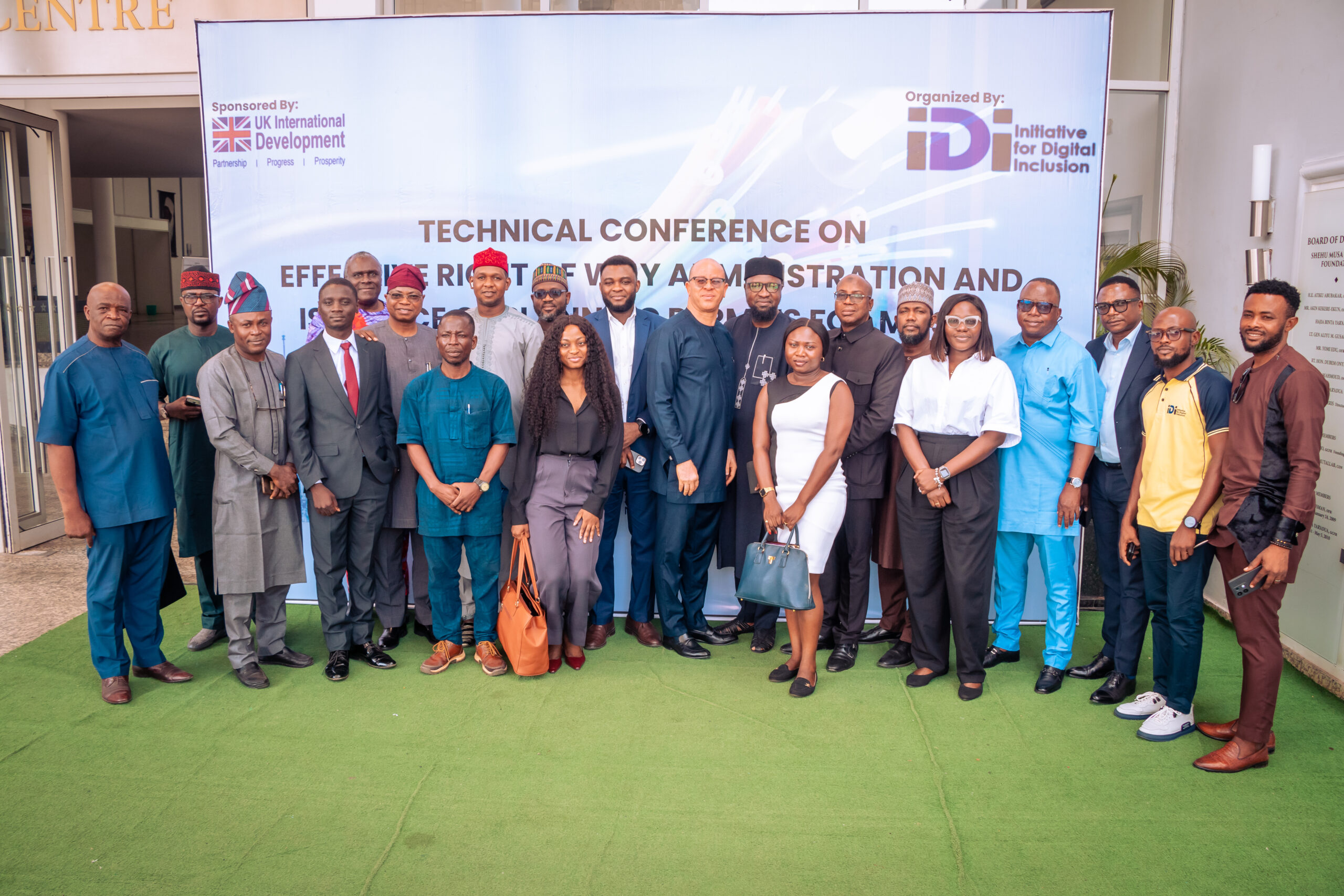
The hybrid conference, held at the Shehu Musa Yar’Adua Centre, Abuja, and online, brought together policymakers, regulators, state governments, telecommunications operators, civil society organisations, and development partners.
The conference provided a platform to present updated project findings, assess progress since 2020, when Phase One of the Right-of-Way Reform Project was concluded and its recommendations were formally presented to federal and state stakeholders, and identify practical, data-driven reforms to accelerate broadband rollout and advance Nigeria’s digital-inclusion agenda.
Right-of-Way Reform as a Strategic Enabler of Broadband Growth
In her welcome address, Ms Grace Bell, First Secretary for Economic Development and Digital Nigeria at the FCDO, reaffirmed the UK Government’s commitment to supporting Nigeria’s broadband expansion through policy reform, technical assistance, and sustained stakeholder collaboration under the Digital Access Programme.
Delivering the opening remarks, Prof. Olalekan Yinusa, Executive Director of the Nigeria Governors’ Forum (NGF), underscored the central role of state governments in improving RoW administration and enabling faster fibre deployment. He highlighted the NGF’s leadership in supporting the National Economic Council (NEC)-recommended ₦145 per linear metre (PLM) RoW benchmark and encouraging states to adopt regulatory and institutional frameworks that attract private investment, reduce approval delays, and strengthen ease of doing business.
Prof. Yinusa welcomed the updated project report and reaffirmed the NGF’s commitment to continued partnership with IDI, regulators, and industry stakeholders to improve sub-national digital-infrastructure governance.
Updated Findings from the Phase Two Right-of-Way Assessment
The technical presentation, delivered by the IDI project team, reviewed the implementation of reforms proposed under Phase One and examined key developments affecting telecommunications infrastructure deployment since August 2020.
Key findings include:
- Expanded adoption of RoW reforms: At least 25 states have adopted favourable Right-of-Way regimes, including zero-fee policies and the ₦145 PLM benchmark, with progress partly driven by incentives under the World Bank-supported State Action on Business Enabling Reforms (SABER) programme.
- Significant fibre expansion: Nigeria has recorded the deployment of over 30,000 kilometres of additional fibre-optic infrastructure since August 2020, indicating improved uptake of RoW processes.
- Persistent approval and coordination challenges: Lengthy approval timelines, fragmented institutional processes, and inconsistent implementation continue to constrain broadband rollout.
- Statistical data and perception gaps: Despite substantial private-sector investment and tax contributions, the economic and fiscal impact of the telecommunications sector remains underestimated at the sub-national level.
The presentation also reviewed major initiatives shaping RoW administration and broadband development, including Project BRIDGE (the Federal Government’s national fibre backbone initiative), the designation of telecommunications assets as Critical National Infrastructure, and ongoing ease-of-doing-business reforms.
Data, Transparency, and Sub-National Governance
During the discussions, Prof. Olalekan Yinusa emphasised that persistent gaps in data availability—exacerbated by the reluctance of some service providers to share information—continue to hinder effective Right-of-Way reform at the state level. He called for greater industry transparency, particularly regarding remittance flows to government.
To address these challenges, he highlighted NGF-led data-building initiatives, including the publication of a Public Digital Infrastructure Report covering all states and the Federal Capital Territory, and the establishment of Datamatics, a centralised repository aggregating key digital and governance indices to support evidence-based policymaking and intergovernmental coordination.
Strengthening Private-Sector Participation in RoW Implementation
Recognising the private sector as the primary driver of broadband infrastructure investment, the conference examined strategies to deepen private-sector engagement in RoW reform implementation. These include coordinated advocacy, improved data transparency, targeted capacity-building for state actors, the development of RoW performance dashboards, and the adoption of modern fibre-deployment technologies that protect public infrastructure.
International best practices from Ghana, South Africa, Australia, India, Ireland, and the United States were referenced, demonstrating how effective public–private collaboration can lower deployment costs and accelerate nationwide broadband expansion.
Policy Alignment and Stakeholder Collaboration
Stakeholder contributions reflected strong alignment across institutions. Representatives of the Nigerian Communications Commission (NCC) highlighted initiatives such as the National Digital Connectivity Index and the Ease-of-Doing-Business Portal, designed to enhance transparency, benchmark state performance, and support data-driven decision-making.
State officials, service providers, and civil society representatives emphasised the need to eliminate hidden charges, harmonise RoW approval processes, and strengthen data-sharing mechanisms to unlock further investment in digital connectivity and services.
Next Steps
Following the Technical Conference, stakeholders committed to translating dialogue into action. IDI will finalise and disseminate the Phase Two Right-of-Way Reform Report to guide policy adoption and implementation by states and regulators. The Nigeria Governors’ Forum (NGF) will continue engaging state governments to promote wider adoption of the ₦145 PLM RoW benchmark, harmonised approval processes, and improved ease of doing business.
Stakeholders also agreed to strengthen data transparency and information-sharing, leveraging NGF data initiatives and regulatory tools to support evidence-based decision-making. IDI and its partners will advance the private-sector engagement framework, deepen inter-agency coordination, and sustain stakeholder engagement to accelerate broadband deployment and expand inclusive digital access across Nigeria.
Advancing Nigeria’s Broadband and Digital Inclusion Agenda
In the closing remarks, the FCDO commended IDI and its partners for advancing constructive dialogue on Right-of-Way reform and broadband policy, confirming that the refined project report will guide continued stakeholder engagement and policy adoption.
As Nigeria advances its digital-economy and broadband-penetration goals, the conference reinforced a clear conclusion: effective, transparent, and data-driven Right-of-Way administration is a critical enabler of broadband expansion, investment attraction, and inclusive digital growth.
The Initiative for Digital Inclusion (IDI) remains committed to supporting governments, regulators, industry stakeholders, and development partners in implementing sustainable RoW reforms that expand digital access and ensure no community is left behind.